Over the past few years, the cannabis industry in the United States has undergone a quiet but significant transformation. While federal marijuana laws remain restrictive, a booming market for hemp-derived products—especially THCA-rich cannabis—has emerged online.
At the heart of this shift is a single piece of legislation: the Agriculture Improvement Act of 2018, commonly known as the 2018 Farm Bill. What started as an agricultural reform law has unintentionally reshaped how cannabis is bought, sold, and consumed across the country.
The 2018 Farm Bill: A Turning Point for Hemp
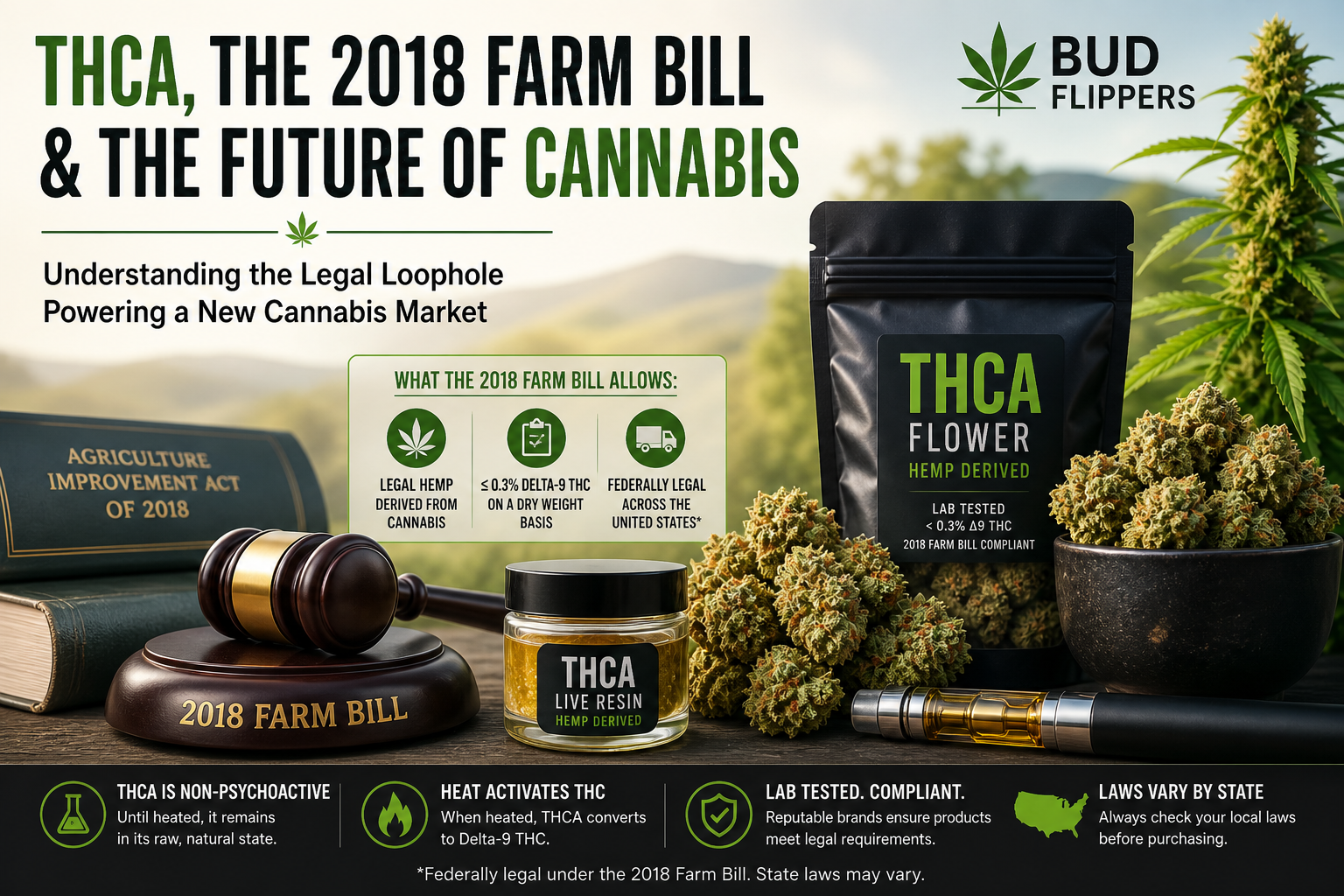
The 2018 Farm Bill fundamentally changed U.S. cannabis policy by legalizing hemp as an agricultural commodity and removing it from the Controlled Substances Act.
Under this law, hemp is defined as cannabis containing no more than 0.3% delta-9 THC on a dry-weight basis.
This definition became the cornerstone of a rapidly expanding hemp industry. Farmers could legally grow hemp, businesses could process it into products, and companies could ship those products across state lines.
But within this seemingly simple definition lay a crucial oversight—one that would reshape the market.
Understanding THCA: The Legal Loophole
THCA (tetrahydrocannabinolic acid) is the natural, non-intoxicating form of THC found in raw cannabis. On its own, it does not produce a psychoactive effect. However, when exposed to heat, THCA converts into delta-9 THC—the compound responsible for the “high.”
The Farm Bill’s definition of hemp focuses specifically on delta-9 THC levels, not THCA.
This distinction created what many refer to as a legal grey area:
- Cannabis products can contain high levels of THCA
- As long as delta-9 THC remains below 0.3%, they may qualify as hemp
- Once heated, these products can produce effects similar to traditional cannabis
This gap between legal definition and real-world use is what sparked the rapid growth of THCA products.
The Rise of Online Hemp Markets
With hemp legalized at the federal level, businesses quickly recognized the opportunity to sell cannabis-like products legally—especially online.
The Farm Bill allows compliant hemp products to be:
- Sold across state lines
- Shipped through major carriers
- Purchased without the need for dispensaries in some cases
This opened the door to a new kind of cannabis economy—digital-first, direct-to-consumer, and nationwide.
Platforms like BudFlippers are part of this growing ecosystem, offering access to THCA flower and related products through online storefronts. These platforms typically emphasize:
- Hemp-derived sourcing
- Lab-tested compliance
- Discreet shipping
For many consumers, especially in states without full legalization, this model provides access to cannabis-like products in a way that wasn’t previously possible.
A Market Built on Technicalities
The rapid growth of THCA products highlights a broader trend: innovation driven by regulation gaps.
Following the Farm Bill, the market expanded beyond CBD into a wide range of cannabinoids, including:
- Delta-8 THC
- THCA flower
- Hemp-derived concentrates
Many of these products fall into the category sometimes called “intoxicating hemp”—products that comply with federal definitions but can still produce psychoactive effects.
This has led to a surge in:
- Online cannabis retailers
- Hemp-based product innovation
- Consumer demand for alternatives to regulated dispensaries
Legal Uncertainty & State-Level Pushback
Despite federal legality, THCA exists in a complex and evolving legal landscape.
States have the authority to regulate hemp products more strictly, and many have begun to:
- Restrict or ban certain cannabinoids
- Introduce “total THC” testing (including THCA)
- Crack down on unregulated sales
This creates a patchwork system where a product may be federally compliant—but not legal in every state.
Additionally, policymakers and regulators are increasingly scrutinizing the THCA market, arguing that it challenges the intent of the original legislation.
The Future of THCA & Hemp Commerce
The success of THCA products—and platforms like BudFlippers—demonstrates how quickly markets can evolve when legislation leaves room for interpretation.
However, the future remains uncertain. Ongoing discussions around updates to federal hemp laws may:
- Redefine how THC is measured
- Close existing loopholes
- Bring THCA products under stricter regulation
If these changes occur, the current online hemp market could shift dramatically.
Final Thoughts
The story of THCA is a perfect example of how science, law, and entrepreneurship intersect in the cannabis industry.
The 2018 Farm Bill didn’t explicitly legalize psychoactive cannabis nationwide—but by focusing solely on delta-9 THC, it created a pathway for THCA products to thrive.
Today, online platforms like BudFlippers represent a new frontier in cannabis access—one shaped by legal nuance, consumer demand, and rapid innovation.
As regulations evolve, one thing is certain:
the hemp industry will continue to adapt, pushing the boundaries of what’s possible within the law.